
Caring for an aging world: How climate services can protect older adults
APR 8 2025
By Priscila Lazaro Vargas and Dr. Jo-Ting Huang Lachmann
Priscila Lazaro Vargas is a student assistant in the CoCareSociety Group at Climate Service Center Germany (GERICS). She is a Master's student in Integrated Climate System Sciences at the University of Hamburg, with a background in Environmental Engineering. Her research focuses on climate change adaptation and the interactions between human activities and the environment.
Dr. Jo-Ting Huang Lachmann is the BMBF Junior Research Group Leader at Climate Service Center Germany (GERICS), Helmholtz-Zentrum Hereon, leading the CoCareSociety project focused on climate services for the care economy and aging society. With over a decade of experience in climate change adaptation, she specializes in socio-economic aspects and urban resilience, contributing to international scientific networks on risk and extreme events.
As the world's population ages, it faces an unprecedented challenge: the escalating impacts of climate change. Rising temperatures, more frequent and intense heatwaves, extreme weather events such as storms and floods, and shifting disease patterns are already affecting millions of people worldwide (1). These changes have particularly severe consequences for older adults, who are more vulnerable to heat stress, displacement due to climate-related disasters, and disruptions in healthcare and essential services (2). In addition to these impacts, the aging population faces growing environmental challenges that disproportionately affect older adults, making this a complex and urgent societal issue (3, 4).
Compounding this vulnerability are socio-economic factors and a lack of awareness about when action needs to be taken. Many older adults, caregivers, and policymakers may not fully recognize the urgency of implementing adaptive measures until extreme events occur. For instance, poor energy efficiency in housing can limit their ability to adapt to rising temperatures, increasing health and mortality risk (4).
Extreme heat, rising energy demands, and disruptions to healthcare services pose significant risks to elderly well-being and require an urgent and coordinated response. While climate services alone cannot fully resolve challenges such as healthcare disruptions, they play a crucial role in developing effective adaptation strategies (5, 6). There is a critical need for tailored climate services that help decision-makers and ageing population understand the complex interplay between climate change, energy demands, and elderly well-being (6). These services are an essential component in identifying solutions, supporting proactive planning, and enhancing resilience in aging societies. However, addressing these challenges requires a comprehensive approach that integrates climate services with policies on healthcare, social protection, and infrastructure adaptation. To maximize their impact, climate services must bridge the current 'usability gap' by providing decision-makers and older adults with actionable, accessible information for climate adaptation.
Climate change in an aging society

The interaction between climate change, long-term care needs, and rising energy demand creates a series of interconnected risks that disproportionately affect older adults (6). For instance, rising temperatures and extreme weather events increase the strain on healthcare systems, potentially limiting older adults' access to essential services. At the same time, energy shortages and rising costs can place financial strain on seniors living on fixed incomes, limiting their ability to maintain safe indoor temperatures or access essential medical equipment (6).
Addressing these cascading risks requires integrated solutions that engage multiple stakeholders across different sectors to enhance adaptation efforts. Climate services play a vital role in this effort, providing actionable information for ageing population at various levels. Older adults can use information to better prepare for heatwaves and extreme weather events to reduce burdens on emergency visits. Care institutions and nursing homes can integrate them to improve building resilience and energy efficiency. City administrations and communities play a key role in developing heat action plans and ensuring equitable access to cooling infrastructure. Additionally, an ageing friendly society benefit from climate services that provide accessible, easy-to-understand information on how to inform neighbors, friends and families to stay safe during extreme climate events.
Recognizing this urgent challenge, the CoCareSociety Project works to co-create a climate-resilient, inclusive, and sustainable society for older adults. Based at the Climate Service Center Germany (GERICS) and funded by the German Federal Ministry of Education and Research (BMBF), CoCareSociety brings together diverse stakeholders, including healthcare institutions, universities, research centers, municipal governments, and civil society organizations. By integrating climate services into healthcare systems, energy efficiency policies, and social care planning, the project seeks to enhance the resilience of older populations. For instance, healthcare providers and municipalities can complement efforts by establishing early warning systems and developing tailored protocols to protect vulnerable populations during extreme weather events.
The role of climate services in elderly care: User-centered climate services
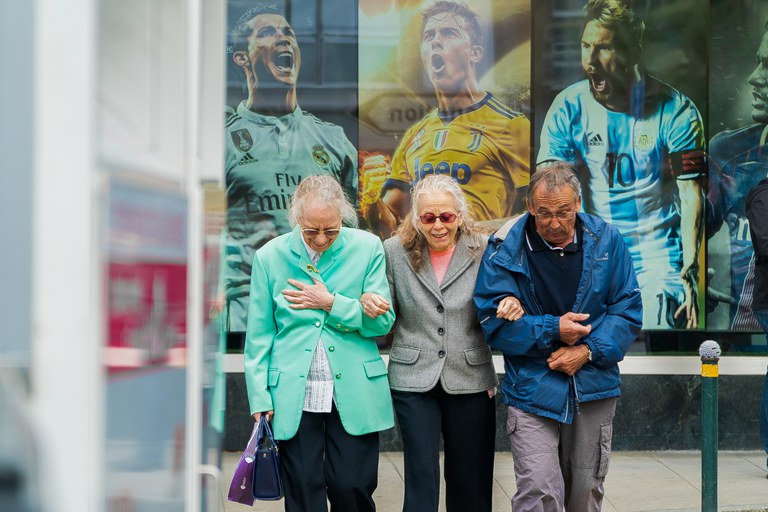
The CoCareSociety Project is pioneering the development of narrative climate services, an innovative methodology that bridges scientific information with the lived experiences of older adults, caregivers, and decision-makers. This approach aims to empower different stakeholders by making climate information accessible and actionable, ultimately fostering informed decision-making and social resilience.
Older adults are one of the primary target groups of the project, but climate services also cater to caregivers, municipal authorities, and healthcare providers, who play a critical role in implementing adaptation measures. Rather than relying on a top-down approach, CoCareSociety emphasizes co-creation, involving older adults in designing adaptation strategies that are relevant to their daily lives and lived experiences. This participatory model ensures that information is not just delivered to older adults, but shaped with them, respecting their autonomy and avoiding the perception of being “taught” by younger generations.
Traditional climate services often fail to reach those who need them most because the information is too technical, fragmented, or inaccessible. To bridge this gap, CoCareSociety develops narratives and user-centered formats, translating climate risks into practical, relatable knowledge.
CoCareSociety narrative-based approach serves multiple purposes:
-
It explains climate information in an understandable manner, breaking down technical barriers that often hinder uptake and action.
-
It encourages community participation in identifying adaptive solutions, ensuring that strategies are grounded in local needs and experiences.
-
It guides policies and strategies aimed at improving social resilience in the care sector, bridging the gap between scientific knowledge and practical implementation.
The narratives integrate multiple dimensions of climate adaptation, exploring questions such as: How do extreme events and changing climate conditions impact the daily lives of older adults across different social contexts? And How do climate risks, socioeconomic conditions, and care networks interact to shape the adaptive capacity of older adults? By addressing these interconnections, the CoCareSociety project supports older adults, caregivers, and decision-makers and ageing population better grasp the complex relationships between climate change, energy systems, and health (5).
Through this user-centered approach, climate services are designed not only to inform but also to empower stakeholders to take actionable steps toward building resilience in aging societies. Fostering a deeper understanding of climate challenges and potential solutions contributes to the development of effective adaptation strategies that benefit older adults and contribute to a more sustainable and inclusive future.
Narratives as examples of climate services
The use of visual and participatory narratives as a learning and action tool allows for a better understanding of climate risks and encourages participation in adaptive behaviors. Narrative-based climate services not only communicate information but also stimulate transformative imagination and help visualize sustainable alternatives for adaptation.
Through specific stories and co-development of actionable solutions, it becomes possible to visualize how different climatic, social, and economic factors interact in the daily lives of older adults and how narratives can facilitate adaptive solutions, as exemplified by John's and Anna’s stories.
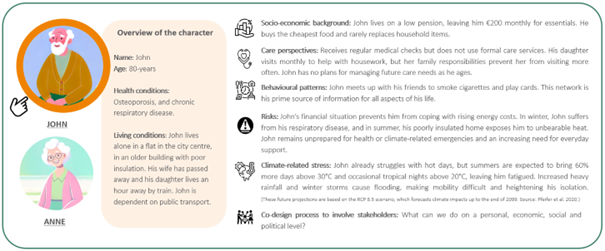
Narratives as Person-Centered Climate Services – John’s case (CoCareSociety, 2025)
This narrative reflects how the lack of climate adaptation can increase the vulnerability of older adults and how narratives can facilitate decision-making to improve their well-being. Through narrative scenarios, John and other participants can visualize practical solutions and understand how to apply adaptation strategies to their daily lives.
In this narrative approach, scenarios such as the following may be explored:
- Simple but effective daily actions to cope with rising temperatures, such as staying hydrated, avoiding direct sun exposure, and ventilating rooms in the early morning to cool indoor spaces naturally.
- How John's home could be retrofitted for better energy efficiency, reducing his exposure to extreme temperatures through insulation, shading solutions, or passive cooling strategies.
- The implementation of community-based early warning systems for heat waves, tailored to the needs of older adults, ensuring they receive timely alerts and support during extreme weather events.
- The development of social support networks that can assist John and others during extreme weather events, reinforcing community resilience and reducing social isolation.
Integrating both small-scale individual actions and broader systemic solutions, this narrative demonstrates how older adults can enhance their adaptive capacity with practical, realistic measures that fit into their daily routines.
Presenting these scenarios in a narrative format makes complex climate adaptation concepts more relatable and actionable for older adults, their caregivers, and policymakers. This methodology can help bridge the gap between scientific knowledge and practical, everyday solutions, empowering communities to build resilience against climate change impacts.
Meanwhile, Anna’s story offers a complementary perspective, illustrating how diverse contexts require equally tailored approaches. You can explore Anna’s narrative in: Narratives by CoCareSociety
Co-development of actionable measures
The CoCareSociety approach is not only focused on creating narratives but also on co-developing solutions through the active participation of communities, researchers, and decision-makers. Through participatory processes, narratives are transformed into concrete actions that enhance the resilience of older adults in the face of climate change.
Integrating climate-informed strategies into elderly care policies at both national and municipal levels ensures that all older adults, regardless of their location, benefit from protective measures against climate extremes. These adaptation tools include tailored heat-health warnings, early warning systems for extreme weather events, and decision-support mechanisms for policymakers and care providers. Among these, narrative-based approaches help translate complex climate data into accessible, real-life scenarios, enabling decision-makers to implement practical adaptation strategies.
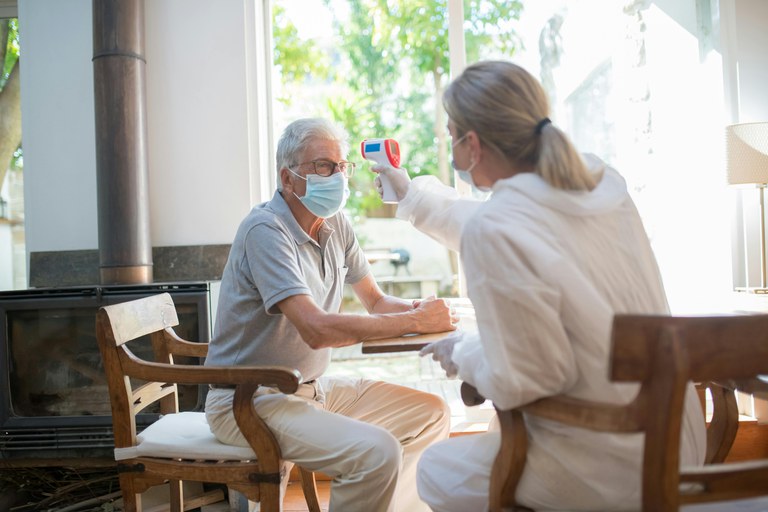
Furthermore, cross-sector collaboration between climate scientists, health professionals, and policymakers fosters innovative solutions that prioritize the unique needs of aging populations. By combining participatory co-creation with policy integration and interdisciplinary collaboration, CoCareSociety bridges the gap between knowledge and action.
Building a resilient society
CoCareSociety's work demonstrates that climate services can become tools that connect science with the everyday lives of people. Through participatory narratives, bridges are built between technical knowledge and real-world needs, driving the creation of more resilient and sustainable societies.
As climate change accelerates and global populations age, integrating climate services into elderly care is not just beneficial—it is essential for creating a resilient and equitable future for all generations. Addressing the unique vulnerabilities of older adults, such as their susceptibility to heat waves, social isolation, and limited adaptive capacity, allows these services to foster inclusive solutions that improve well-being while mitigating climate risks.
To learn more about these narratives and explore them in detail, visit the website: cocaresociety.de
References
(1) Global Center on Adaptation. (2025). The growing threat of extreme weather. https://gca.org/the-growing-threat-of-extreme-weather/
(2) Falchetta, G., De Cian, E., Sue Wing, I. et al. (2024). Global projections of heat exposure of older adults. Nat Commun 15, 3678. https://doi.org/10.1038/s41467-024-47197-5.
(3) Filiberto, D., Wethington, E., Pillemer, K., Wells, N., Wysocki, M., & Parise, J. T. (2009). Older people and climate change: vulnerability and health effects. Generations, 33(4), 19-25.
(4) Ellena, M., Breil, M., & Soriani, S. (2020). The heat-health nexus in the urban context: A systematic literature review exploring the socio-economic vulnerabilities and built environment characteristics. Urban Climate, 34, 100676.
(5) Raaphorst, K., Koers, G., Ellen, G. J., Oen, A., Kalsnes, B., van Well, L., Koerth, J., & van der Brugge, R. (2020). Mind the Gap: Towards a Typology of Climate Service Usability Gaps. Sustainability, 12(4), 1512. https://doi.org/10.3390/su12041512.
(6) Katsaros K., Marggraf C., Ebi K.L., Buyana K., Hashizume M., Lung S-C.C., Murray V., Thiam S., Huang-Lachmann J-T. (2024). Exploring interconnections: A comprehensive multi-country analysis of climate change, energy demand, long-term care, and health of older adults, Maturitas, Volume 184, 107961, ISSN 0378-5122, https://doi.org/10.1016/j.maturitas.2024.107961.
(7) United Nations. (2023). World Social Report 2023: Leaving no one behind in an ageing world. Department of Economic and Social Affairs. https://www.un.org/development/desa/dspd/wp-content/uploads/sites/22/2023/01/2023wsr-chapter1-.pdf